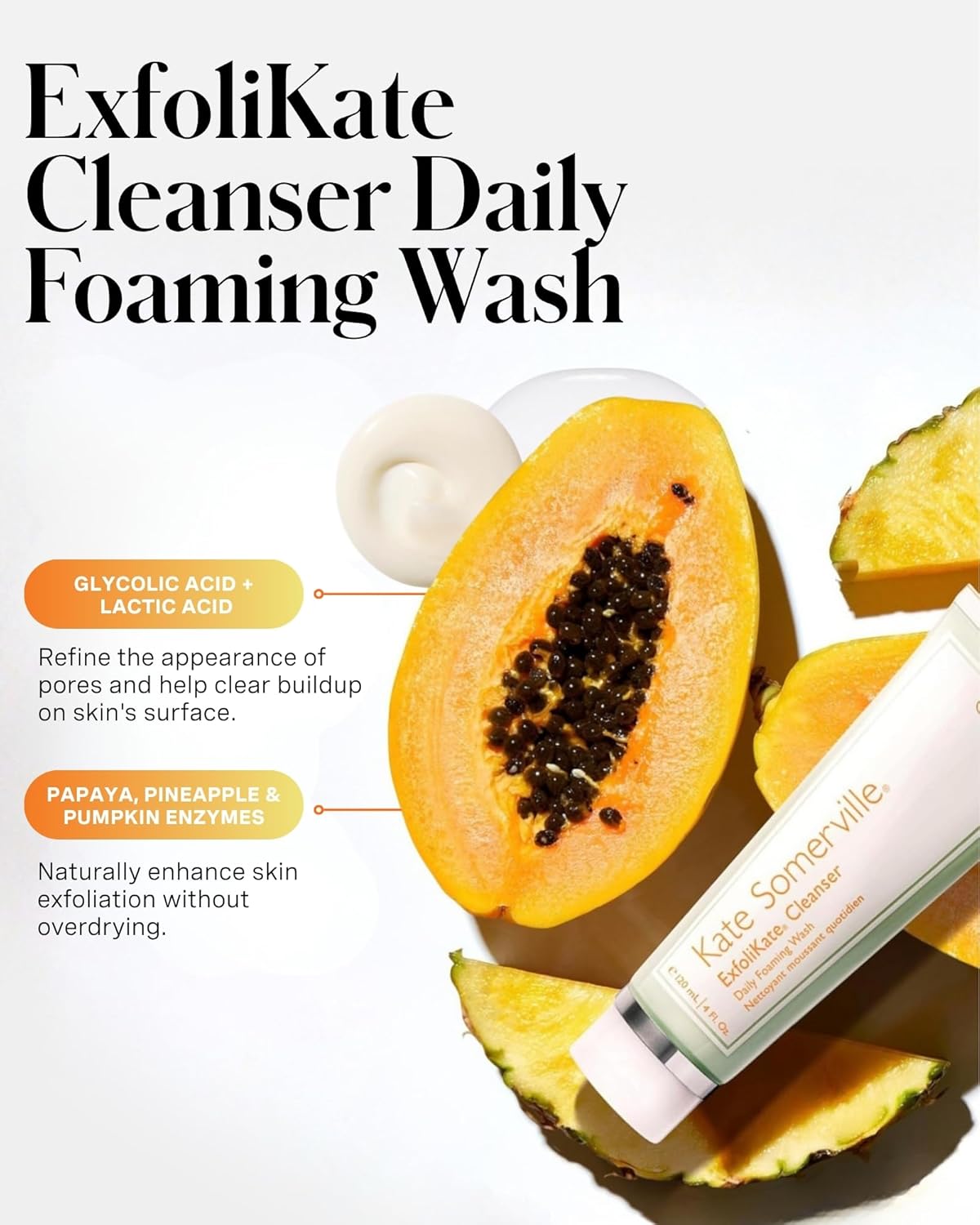
You’ve probably noticed the letters AHA, BHA, or PHA showing up on cleanser labels and thought: are those the same acids I see in serums and toners? They are. AHA stands for alpha hydroxy acid — a family of water-soluble acids (like glycolic and lactic) that dissolve the bonds holding dead skin cells together so they shed more evenly. BHA stands for beta hydroxy acid — salicylic acid is the main one — and it’s oil-soluble, meaning it can travel into pores rather than working only at the surface. PHA stands for polyhydroxy acid, a newer, gentler cousin that exfoliates more slowly and is better tolerated by sensitive skin. These three categories appear in everything from $12 drugstore scrubs to $65 prestige cleansers, and the marketing around them is confident. What the marketing doesn’t always tell you is how much contact time — the seconds a product actually sits on your skin — changes the math completely. This guide breaks that down honestly, so you can decide whether an acid-spiked cleanser earns its place in your routine or whether your money is better spent elsewhere.
Contact Time Is the Variable No One Advertises
Here’s the core tension in every acid cleanser, and it’s worth naming plainly before anything else: exfoliating acids need time at the correct pH to do meaningful work, and most cleansers are on your face for thirty to sixty seconds before you rinse.
Paula’s Choice Expert Advice — specifically their resource on how exfoliants work — is direct about this: leave-on formulas like toners and serums are designed to maintain contact long enough for acids to penetrate the stratum corneum (the outermost layer of skin). Rinse-off formulas interrupt that window.
Does that mean acid cleansers are useless? Not exactly — the tradeoff is more nuanced than a binary yes/no.
What rinse-off acids can do:
- Lower the surface pH of skin briefly, making the cleansing environment slightly more favorable for the acid to begin acting
- Provide a mild, cumulative exfoliating effect with daily use over weeks
- Deliver secondary benefits unrelated to exfoliation — salicylic acid, for example, has documented antimicrobial and anti-inflammatory properties that may benefit acne-prone skin even in short contact
What rinse-off acids cannot reliably do:
- Match the cellular turnover impact of a 5–10% AHA leave-on applied for hours
- Deliver the pore-clearing depth that a dedicated BHA serum achieves over a sustained contact window
- Function at the concentration percentages that clinical studies are typically based on, since cleanser formulas often use lower percentages specifically because the product is meant to be washed away
The Beauty Brains — a cosmetic chemistry resource run by industry formulators — have addressed this repeatedly: the efficacy gap between rinse-off and leave-on isn’t a marketing myth. The chemistry is real. That doesn’t make acid cleansers worthless; it means you should know what job you’re actually hiring them to do.
AHA, BHA, PHA: The Tradeoff Table
The three acid families behave differently enough that choosing the wrong category for your skin type is a genuine mistake, not just a matter of preference.
By the numbers — typical cleanser concentrations vs. leave-on benchmarks:
| Acid type | Typical cleanser % | Leave-on clinical range | Skin type fit |
|---|---|---|---|
| AHA (glycolic/lactic) | 2–5% | 5–15% | Dry, dull, uneven tone |
| BHA (salicylic) | 0.5–2% | 1–2% | Oily, acne-prone, congested pores |
| PHA (gluconolactone/lactobionic) | 3–8% | 5–10% | Sensitive, rosacea-adjacent, dry |
Sources: Healthline’s overview of AHA vs. BHA; Cosmetics & Toiletries analysis of PHA formulation ranges.
A few things jump out of that table. First, BHA is the acid family whose cleanser-range concentrations actually overlap with the leave-on clinical range — which is one reason salicylic acid cleansers have a more credible evidence base for acne-prone skin than, say, a 3% glycolic cleanser does for resurfacing. Second, PHAs sit at higher percentages in cleansers because the molecule is larger and penetrates more slowly — that’s also what makes them better tolerated on reactive skin, per Cosmetics & Toiletries’ formulation literature on polyhydroxy acids.
AHAs in cleansers make the most sense if your goal is texture maintenance and brightening rather than transformation. A daily glycolic or lactic cleanser won’t replace your weekly AHA treatment, but reviewers at Byrdie consistently note that users with generally smooth skin who want to preserve radiance find consistent results with AHA cleansers used as part of a multi-step routine. If you’re starting a new AHA leave-on treatment, be careful about doubling up — two sources of glycolic acid in the same routine, even at different contact times, can accumulate irritation, especially in winter months when the skin barrier is already under stress.
BHAs in cleansers have the most defensible use case. Salicylic acid’s oil solubility means it can do meaningful work in a shorter window than AHAs can, and its anti-inflammatory properties add value independent of exfoliation depth. Healthline’s AHA vs. BHA overview notes that salicylic acid has been studied extensively for acne management, and some of that benefit carries over to rinse-off formats — particularly for reducing surface bacteria and calming active breakouts. If you’re managing persistent congestion in the chin or nose zone, a 1–2% salicylic cleanser used daily is a reasonable front-line tool, as long as you’re not relying on it as your only acne intervention.
PHAs are the most under-discussed of the three, and arguably the best fit for an intermediate practitioner building a sensitive-skin routine. The large molecular size that slows penetration also reduces the risk of irritation — which is why Cosmetics & Toiletries’ formulation literature positions PHAs as appropriate for skin with compromised barriers, post-procedure skin, and conditions like rosacea where standard AHA concentrations can trigger flares. PHA cleansers tend to be gentler than their acid percentage suggests, and reviewers who’ve tried them after struggling with glycolic tend to report a noticeable difference in tolerance.
How to Actually Decide: The “If X, Then Y” Framework
You’re not buying an acid cleanser as a conceptual exercise — there’s a real routine decision here. Let’s map the decision tree explicitly.
If your primary goal is visible resurfacing or tone correction: Don’t spend your budget on an AHA cleanser to do that job. A 5–10% lactic or glycolic leave-on serum or toner applied after cleansing will deliver meaningfully more than any glycolic cleanser at double the price. In this case, a gentle non-acid cleanser is the smarter pairing — it preserves your budget for the step where acids actually have time to work.
If your primary concern is blackheads, congested pores, or acne: This is where an acid cleanser earns its place. A 1–2% salicylic BHA cleanser as your daily morning step — particularly in oilier skin types — has a credible rationale even in rinse-off format. The EWG Skin Deep database rates salicylic acid as low hazard at standard cleanser concentrations, and the anti-inflammatory action works faster than AHA’s cell-turnover mechanism, making the short contact window less of a limiting factor. Pair it with a non-acid evening cleanser and your BHA leave-on (if you use one) on alternating nights to avoid over-exfoliation.
If you have sensitive, reactive, or barrier-compromised skin: PHA is your acid category. But consider whether the goal is exfoliation at all — a compromised barrier needs repair before it needs exfoliation. If your skin has been through a heavy retinol phase, a recent peel, or a rough winter, a PHA cleanser at a mid-range concentration can provide the mildest possible exfoliating maintenance without setting back recovery. If your skin is actively inflamed or peeling, pull the acid cleanser entirely until the barrier has rebuilt.
If you’re already using a strong leave-on exfoliant (retinoid, AHA serum, mandelic acid): Adding an acid cleanser on top is almost always a net negative. The incremental exfoliating benefit is marginal; the irritation risk is real. This is one of the cleaner tradeoff calls: your leave-on is doing the work, your cleanser should be neutral. The one exception is a BHA cleanser used on the mornings you’re not applying your leave-on actives — that rotation logic is something estheticians recommending take-home regimens often use, per practitioner-oriented content on Credo Beauty’s editorial resources.
If you’re building a routine for someone else (gift-giving, esthetician recommendation): Default to PHA or low-concentration BHA. You don’t know the recipient’s current exfoliant load, and AHA cleansers carry more irritation risk when stacked unknowingly. A PHA-forward cleanser in the mid-tier — around the $30–$40 range — is a safer recommendation that works across skin types and won’t conflict with someone else’s existing serums.
The Formulation Details That Actually Matter
Beyond the acid category, two formulation variables separate an effective acid cleanser from a marketing exercise:
pH of the formula. Hydroxy acids work optimally at a pH between roughly 3.5 and 4.0; at skin’s natural pH of ~5.5, the exfoliating reaction slows significantly. Most acid cleansers don’t disclose pH on the label, but the Beauty Brains formulation resources note that reputable brands typically buffer their acid cleansers low enough for some activity. If a cleanser lists its acids near the bottom of the INCI (ingredient list, ranked by concentration), and the formula also contains significant amounts of pH-raising ingredients like sodium bicarbonate or high concentrations of botanical waters, you’re likely looking at a formula where the acid is more of a marketing bullet than an active contributor.
Buffering and supporting ingredients. An acid cleanser that also contains barrier-supporting ingredients — ceramides, panthenol, niacinamide — is a meaningfully different proposition than a pure acid wash. The barrier support extends the window during which the acid can work without causing dryness or disruption. This is especially relevant for BHA cleansers targeting acne-prone skin: salicylic acid is inherently drying, and a formula that doesn’t compensate can compromise the barrier you need intact for healing.
The bottom line is honest: acid cleansers are a supporting role in a well-built routine, not the lead. When the acid matches the skin type (BHA for congestion, PHA for sensitivity, AHA for maintenance on otherwise stable skin), when the concentration is real, and when you’re not doubling up unnecessarily with leave-on actives, they earn their spot. When they’re chosen because the label sounds impressive — or used as a substitute for the leave-on step that would actually deliver results — they’re an expensive way to wash your face.